
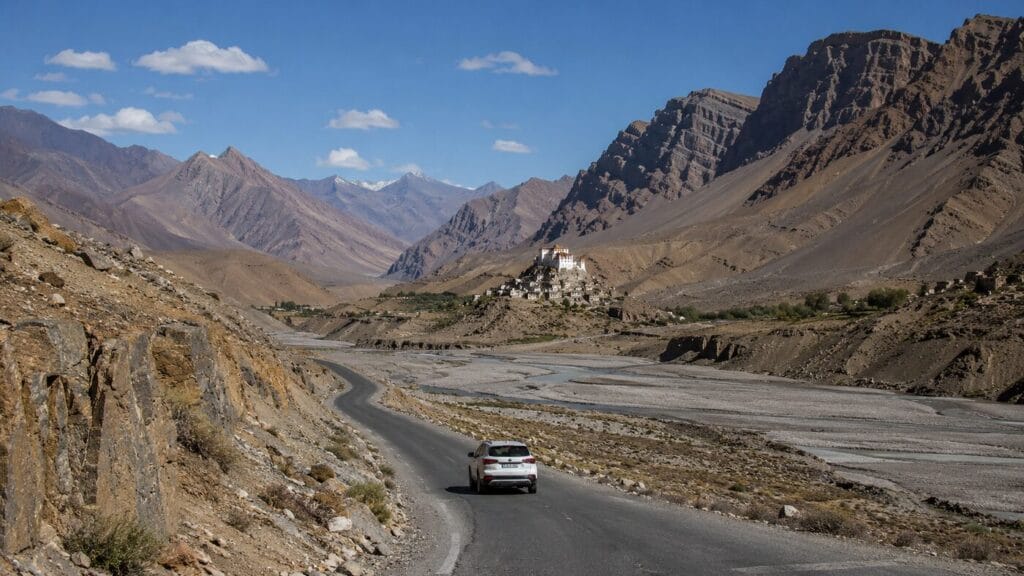
A Delhi to Spiti Valley road trip is not an ordinary hill-station drive. The route reaches high altitude, crosses long low-service sections and can change because of snow, landslides or road work. A successful trip depends less on rushing through a checklist and more on acclimatisation, daylight driving and a mechanically sound vehicle.
For most first-time travellers, entering through Shimla and Kinnaur gives a more gradual gain in altitude than the Manali–Kunzum side. This guide therefore uses the Shimla route and treats the Manali exit as seasonal, not guaranteed.
Delhi to Spiti route overview
| Approximate distance to Kaza | Roughly 730–780 km via Shimla, depending on stops and diversions |
|---|---|
| Recommended driving days to Kaza | Three days from Delhi |
| Core route | Delhi – Shimla – Rampur – Reckong Peo/Kalpa – Nako – Tabo – Kaza |
| Ideal total duration | 8–10 days |
| Best broad window | Late spring to early autumn, subject to current road status |
Why the Shimla route is practical
The Shimla–Kinnaur route normally remains the more dependable access corridor for a longer season, and its staged ascent helps travellers adjust. The Manali route involves high passes and the Kunzum section, which may remain closed well beyond winter. Never build a fixed return ticket around an unverified pass opening.
Suggested 8-day Spiti itinerary
Day 1: Delhi to Shimla or Narkanda
Start early and keep the first day simple. If the group reaches Shimla comfortably, continuing to Narkanda can reduce the next day, but it should not become a night drive.
Day 2: Narkanda to Kalpa
Travel through Rampur and the Sutlej valley. Expect slow mountain sections. Stay around Reckong Peo or Kalpa and keep the evening free for rest.
Day 3: Kalpa to Tabo via Nako
Carry water and snacks before entering long sparse stretches. Stop at Nako only if the schedule remains comfortable, then continue to Tabo for the night.
Day 4: Tabo, Dhankar and Kaza
Visit Tabo respectfully, then proceed toward Dhankar according to road status and time. Reach Kaza before evening and avoid strenuous activity immediately after arrival.
Day 5: Kaza acclimatisation and nearby villages
Use a slow day for nearby monasteries and villages. Do not turn the day into a race between high viewpoints. Hydration and rest are more important than covering every location.
Day 6: Kaza to Kalpa or Rampur
Return on the same dependable route unless the Manali side is officially open and the driver and vehicle are prepared for it.
Day 7: Kalpa/Rampur to Shimla
Complete the middle mountain section in daylight and stay near Shimla.
Day 8: Shimla to Delhi
Return to Delhi with regular breaks. Our Delhi to Shimla road guide covers this final corridor.
Permits and identity documents
Permit requirements depend on nationality and the exact border-area route. Indian citizens should still carry valid government photo identification and vehicle papers. Foreign travellers may need permits for specified protected inner areas in Kinnaur and Spiti. The official Himachal Tourism safety guidance specifically notes Inner Line Permit requirements for foreign tourists in certain border areas. Confirm the current rule with the relevant district authority rather than relying on an old blog.
Altitude and health precautions
- Ascend gradually and sleep lower on the first mountain nights.
- Avoid alcohol and unusually hard exercise while acclimatising.
- Persistent headache, nausea, confusion or breathlessness should not be ignored; descend and seek medical help.
- Keep prescription medicines and basic supplies accessible, not buried under luggage.
Vehicle and road preparation
Tyres, brakes, cooling, spare wheel and ground clearance matter more than cosmetic features. Fuel up before sparse sections and do not overload the roof. A skilled local or experienced Himalayan driver is strongly preferable. Groups comparing vehicles can read Tempo Traveller vs Force Urbania, but availability should never override route suitability.
Frequently asked questions
How many days are needed for Spiti from Delhi?
Eight days is a compact minimum via Shimla. Nine or ten days provides better weather buffers and less daily fatigue.
Can a normal car reach Kaza?
Many cars travel the Shimla route in good conditions, but road damage can change the requirement. Vehicle condition and driver judgement are more important than a simple model label.
Is mobile network available everywhere?
No. Carry offline maps, printed booking details, emergency contacts and enough cash for locations where digital payment or connectivity is unreliable.